How Far in Advance Do Guests Book? Read Your Booking Curve
Every host has stared at an empty calendar for next season and felt the urge to slash prices. Most of the time that urge is wrong. The reservations for that season simply have not arrived yet, because guests book in a rhythm that repeats year after year. Learn to read that rhythm - your booking curve - and you can price with confidence, know when to raise and when to hold, and stop panicking over empty months that are supposed to be empty.
Booking date vs check-in date: the one distinction that matters
Two dates hide inside every reservation, and hosts constantly mix them up:
- Booking date - the day the guest hit "book" and the reservation landed in your inbox.
- Check-in date - the day the guest actually arrives and starts their stay.
The gap between the two is your booking lead time, also called the booking window. A guest who reserves in March for a stay in July has a lead time of about four months. Your occupancy calendar answers "when are guests staying". The When guests book chart answers a different and just as important question: when do the reservations actually come in. That is the number that tells you when to expect demand and when to act on price.
The by-month view: your booking curve for the year
Open When guests book and the first chart shows how many reservations were made in each month of the selected year. This is your booking curve. It does not show when guests stay - it shows when they booked.
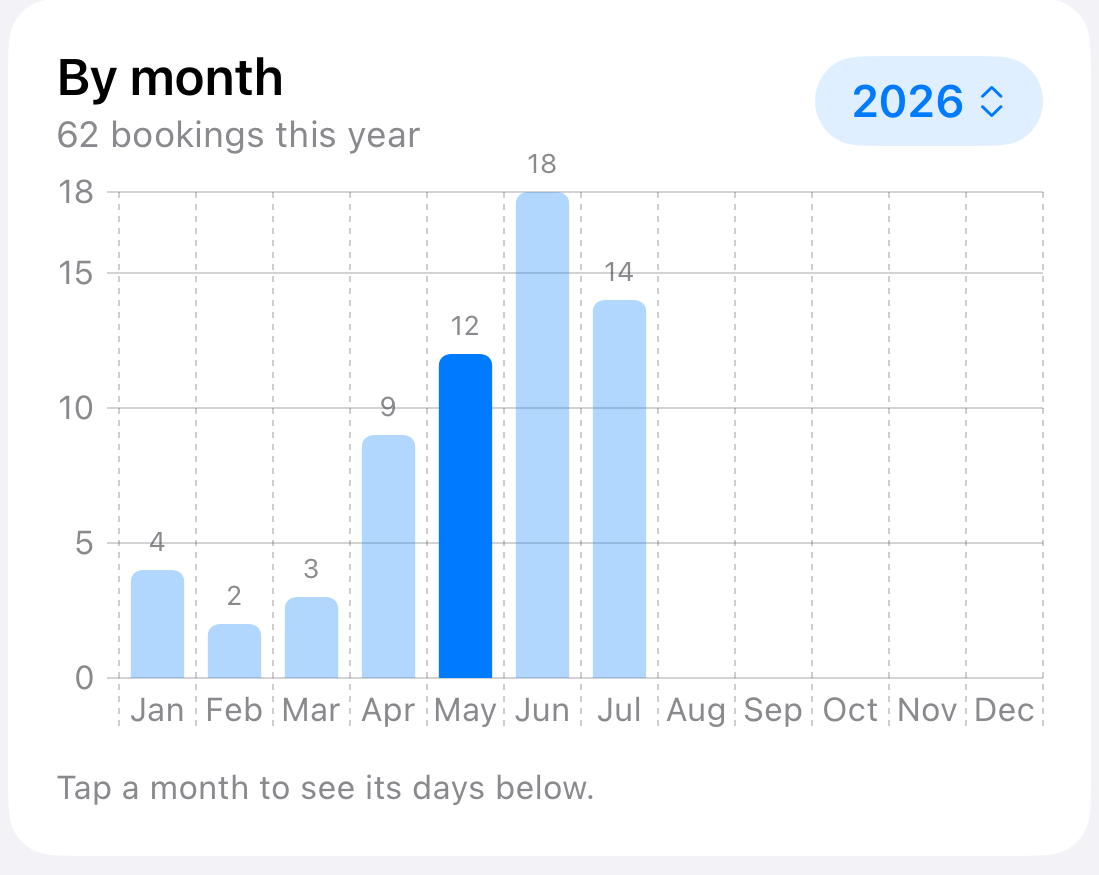
Bookings by the month they were made - a quiet winter, then reservations pour in from spring into summer
Read the shape, not just the total. In the example above the year opens quietly, then reservations climb through spring and peak in early summer. That peak is not when guests stay. It is when the inbox fills up for the whole warm season ahead. Once you know that shape, you know roughly when next year's reservations will start arriving too, because guest behaviour repeats far more than nightly rates do.
Zoom into a month: the by-day view
Tap any month and the same reservations break down day by day. This tells you whether bookings trickle in evenly or cluster - around weekends, paydays, a holiday weekend, or the day you dropped a price.
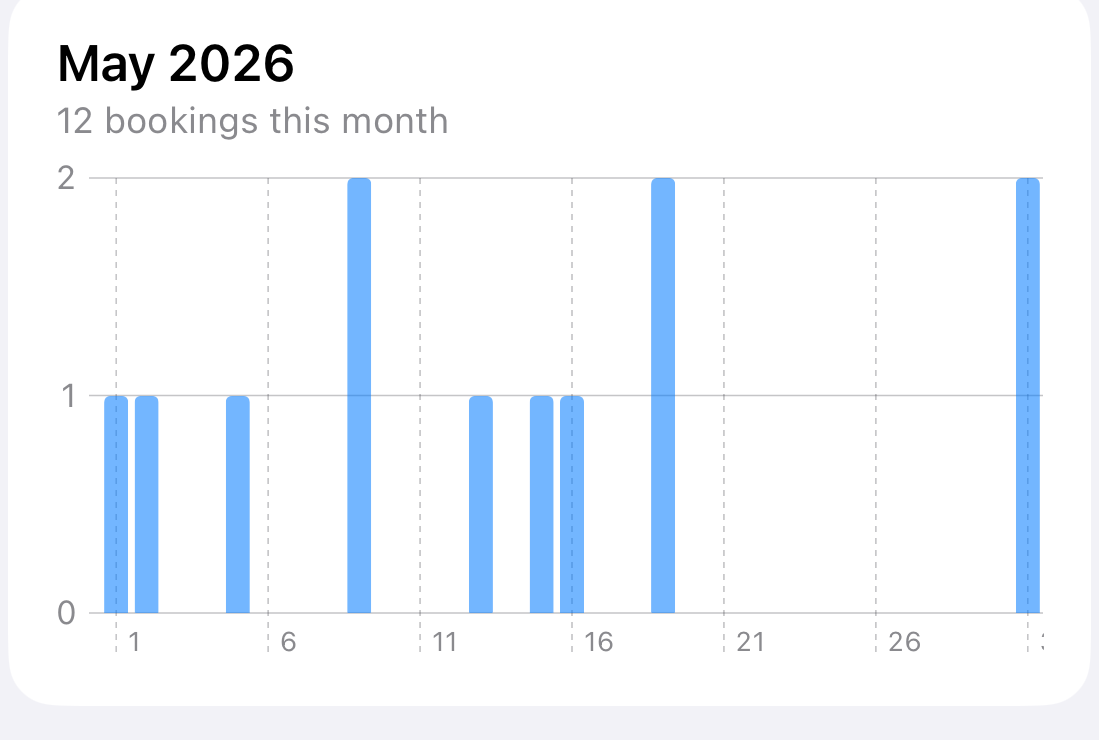
The same month, day by day - useful for spotting clusters around weekends and holidays
The daily view is where you catch cause and effect. If reservations spike right after you adjusted a price or a listing photo, you can see it. If a normally busy stretch went quiet, you can see that too, while there is still time to react.
What your booking curve tells you
Once you can see when reservations arrive, three practical things fall out of it:
- Your real booking window. Cross-reference a few bookings' booking dates against their check-in dates and you learn how far ahead your guests commit. In a summer market that might be two to four months; in a city market it might be two weeks. Yours is whatever your own data says, not a blog average.
- Your peak booking months. The tall bars are the months your calendar fills for the season. Those are the weeks to have your prices dialled in and your listing looking its best, because that is when the demand is deciding.
- Your normal pace. Compare this year to last year at the same point using the year selector. Being "behind" only means something relative to your own history, not to an empty spot on the calendar.
Using your booking curve to price next year
This is where booking timing turns into money. Pricing is not one decision, it is a sequence of them timed to your curve:
- Before your booking window opens - set competitive prices for the season while guests are just starting to look. If most of next summer books in spring, spring is when your summer prices need to be right, not July.
- As dates fill up - raise prices on the nights that are selling. High demand in your peak booking months is your permission to push rates on what is left.
- When a date lags - if a night is still empty well past the point it normally books, that is your genuine signal to lower the price. Dropping earlier, before your window even opens, just discounts nights that would have sold anyway.
Why an empty calendar months out is normal
Here is the reassurance every host needs printed on the wall. If your booking curve shows that most of a season's reservations arrive one to three months before check-in, then a calendar that looks empty four or five months out is not a warning sign. It is the expected state of the world at that moment.
The mistake is comparing an empty future month to a full one and concluding something is wrong. The right comparison is against the same date last year. If you had the same number of bookings on the calendar this time last year, and last year turned out fine, you are on track. Your booking curve gives you that baseline so you can wait out the quiet stretch instead of panic-pricing through it.
How to read it in Hosta
It takes about a minute once your bookings are in the app.
Open When guests book
Open the When guests book chart. The top card shows reservations by the month they were made, for the year you pick. Remember: these bars are booking dates, not stays.
Find your peak booking months
Look for the tall bars. Those are the months your calendar fills for the season ahead. That is when your prices and listing need to be ready, because that is when guests are deciding.
Tap a month for the daily view
Tap any month to see the same reservations day by day. Use it to spot clusters around weekends and holidays, and to see how bookings responded after a price or listing change.
Compare year over year
Switch the year selector to last year and check your pace at the same point in the calendar. Ahead, behind or on track against your own history is the only comparison that matters.
Frequently asked questions
How far in advance do guests book short-term rentals?
It depends on your market and season, so trust your own data over any average. City stays often book days to a few weeks out, while summer and holiday destinations can book months ahead. Your booking curve shows when your reservations actually arrive, which is the number that should drive your pricing.
What is booking lead time and why does it matter?
Booking lead time is the gap between the day a reservation is made and the day the guest checks in. It tells you how early to have prices set, when to start raising rates as dates fill, and how empty a future month should look right now.
Does When guests book show the check-in date or the booking date?
The booking date - the day each reservation was created, not the day the guest arrives. That is the point: it reveals when demand lands in your inbox. To see how far ahead a single stay was booked, compare its booking date with its check-in date.
My calendar is empty for next summer. Should I worry?
Usually not. If most of last summer's reservations came in during spring, an empty summer calendar in winter is exactly what to expect. Compare your pace to the same point last year rather than to the number of empty nights.
How do I use booking timing to set prices for next year?
Have competitive prices in place before your peak booking months open, raise prices on dates as they fill, and only lower a price once a date has lagged past the point it normally books. Your booking curve tells you when each of those moments arrives.